3D graffiti
Learn all about 3D graffiti. Discover the history, technical shading techniques, and how professional artists create depth and realism without outlines.
3D graffiti is one of the most visually stunning and technically demanding styles in the world of urban art. Moving away from the flat, two-dimensional roots of early street art, 3D graffiti—also known as "FX style"—uses the principles of fine art, such as perspective and light theory, to make letters literally "pop" off the wall. Whether it’s metallic textures, floating blocks, or mind-bending anamorphic illusions, this style represents the peak of technical can control. In this guide, we explore the origins, techniques, and professional secrets behind creating three-dimensional masterpieces on a flat canvas. 🖌️✨
What is 3D graffiti?
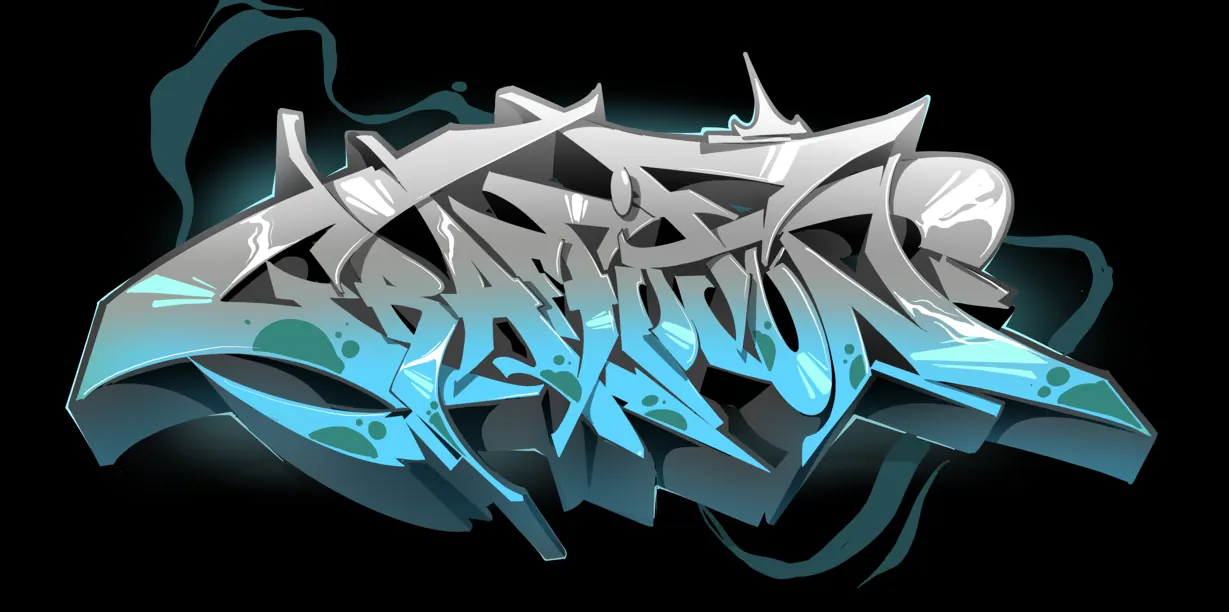
3D graffiti, often referred to as "FX" or "Style Writing with Dimension," is a highly technical sub-genre of urban art that focuses on creating the illusion of depth, volume, and three-dimensional space on a flat surface. Unlike traditional graffiti, which relies heavily on a distinct outline to define letters, 3D graffiti often abandons the outline altogether. Instead, it uses light, shadow, perspective, and colour gradients to make letters appear as though they are physical objects protruding from or receding into the wall. 🎨
The visual characteristics of 3D letters
When you look at a 3D piece, the first thing you notice is the lack of a traditional hard outline. In a standard graffiti piece, a dark line usually separates the letter from the background. In 3D styles, the separation is created by "value" (the lightness or darkness of a colour). Professional artists use multiple shades of the same hue to simulate how light hits a physical object. You will see highlights where the "sun" would hit the top edges and deep shadows where the letter would cast a silhouette upon itself.
Common visual elements include:
- Vanishing points: All lines of depth converge toward a single point to create a realistic perspective.
- Complex bevels: Letters aren't just flat blocks; they have rounded edges, sharp corners, and metallic textures.
- Interlocking parts: Characters and letters often wrap around each other in a way that suggests physical weight.
- Realistic textures: Many 3D artists incorporate textures like chrome, stone, or liquid into their work.
The origins and evolution of 3D styles
The journey of 3D graffiti began in the late 1970s and early 1980s in New York City. While early pioneers were experimenting with simple "blockbusters" to make letters look heavy, the style truly evolved when artists began to look beyond the subway car and toward the world of graphic design and illustration. 🏙️
The phase of "The Block"
Early graffiti relied on simple "3D blocks"—a basic shadow cast to one side of a letter. However, as the 1980s progressed, artists like Phase 2 and Donnie began pushing the boundaries of letter structure. They started adding more complex angles. This was the bridge between 2D lettering and the eventual explosion of the "FX" style.
The European influence and the FX crew
In the 1990s, the style took a massive leap forward, particularly in Europe. Artists like Daim from Germany and the FX Crew from New York redefined what was possible with a spray can. They moved away from the "letter-first" approach and began treating the wall like a canvas for architectural rendering. They introduced the concept of "photo-realism" into graffiti, using highly controlled cap types to create soft fades and razor-sharp highlights without needing a black outline.
3D graffiti vs. Wildstyle
It is common for beginners to confuse 3D graffiti with Wildstyle. While both are complex, they focus on different artistic priorities. Wildstyle is about the intricate "skeleton" and interlocking of the letters—the connections, arrows, and breaks. A Wildstyle piece can be painted flat or with 3D elements. 3D graffiti, however, prioritises the volume of those letters. In 3D style, the "engineering" of the light source is just as important as the shape of the letter itself.
Technical requirements: Mastering the spray can
Painting 3D graffiti is arguably one of the most difficult skills in the urban art world. It requires a deep understanding of physics, particularly how light behaves. Professional artists must plan their pieces meticulously, often starting with a detailed sketch in a blackbook.
Light sources and shadows
The most critical rule of 3D graffiti is consistency. An artist must decide where their imaginary light source is coming from (e.g., the top left corner). Every single highlight must be on the top left of the surfaces, and every shadow must fall to the bottom right. If the light source is inconsistent, the 3D illusion "breaks," and the piece looks flat or confusing to the eye.
The "No Outline" challenge
Most graffiti artists rely on the "final outline" to hide mistakes or clean up messy edges. In 3D graffiti, you often don't have this luxury. Each edge is defined by the transition from a light colour to a dark colour. This requires incredible "can control"—the ability to spray soft, transparent layers of paint (glazing) to build up depth slowly.
Skill level, time investment, and audience fit
Because of its technical nature, 3D graffiti has specific requirements for those looking to try it. ⏱️
- Skill Level: Advanced. While beginners can learn the basics of perspective, executing a full 3D piece requires months or years of practice with pressure control and colour blending.
- Time Investment: High. A high-quality 3D piece can take 2 to 3 times longer than a standard throw-up or simple piece. The layering process and shading take significant patience.
- Audience Fit: This style appeals to those who love technical drawing, architecture, and realism. It is often a favourite for corporate murals because of its "clean," polished look that resembles digital 3D modelling.
Modern adaptations and digital influence
Today, 3D graffiti has evolved alongside technology. Many artists use 3D modelling software to "stress test" their letter designs before hitting the wall. This allows them to see how shadows would fall on complex, twisted shapes in a virtual environment. We also see the rise of "Anamorphic Graffiti," where the artist paints the piece across corners or uneven surfaces so that it appears to hover in mid-air when viewed from a specific angle.
3D graffiti in workshops
At Graffitifun, we believe everyone can learn the principles of 3D, even if they are total beginners. In our professional workshops, we break down these complex theories into manageable steps. 🎨🔧
How we teach 3D
- Identifying the Light Source: We teach participants to imagine a sun in the corner of their canvas.
- Simple Geometry: We start by turning a flat letter into a "block" using vanishing points.
- Blending Techniques: We demonstrate how to use professional caps to create the soft gradients needed for rounded 3D effects.
- Highlighting: The "magic" moment where we add a final white "flash" to the edges, making the artwork pop off the surface.
While mastering the style takes a lifetime, a workshop provides the perfect foundation to understand how artists "trick" the eye into seeing depth on a flat wall.
Expert attribution: A legacy of urban education
This guide was compiled by the expert team at Graffitifun. With years of hands-on experience and a global network of professional graffiti artists, we have spent decades teaching the technical nuances of 3D styles to students, corporate teams, and art enthusiasts. Our artists have seen the evolution of the "FX" style firsthand and bring that professional precision to every workshop and mural we create. We pride ourselves on making even the most advanced techniques—like 3D perspective—accessible, fun, and safe for everyone. 🚀
Frequently asked questions
Keep reading
Ready to Create Your Masterpiece?
Book your graffiti workshop today and discover the artist within! It's going to be AWESOME!