Blackbook
Learn everything about the graffiti blackbook. Discover its history, why artists use them, and how sketchbooks are the foundation of urban art education.
If you've ever spent time around urban artists or attended a professional graffiti workshop, you’ve likely heard the term "blackbook" mentioned with a sense of reverence. A blackbook is the essential "holy grail" for any graffiti writer, serving as a personal portfolio, a training ground, and a historical record of their artistic journey. It is where raw ideas are transformed into polished masterpieces through hours of disciplined sketching. In this comprehensive guide, we will explore the origins of the blackbook, its vital role in the graffiti subculture, and why it remains the most important tool for both beginners and seasoned professionals in the world of aerosol art. 📓
What is a blackbook?
In the world of urban art, a blackbook is much more than just a sketchbook. It is a portable portfolio, a personal diary, and a sacred archive of a writer's evolution. Traditionally a black, hardbound sketchbook (hence the name), it serves as the primary tool for honing skills, planning complex pieces, and exchanging "burners" with other artists. For professional graffiti artists, the blackbook is the foundation of their craft, where every masterpiece begins its life as a graphite sketch before ever meeting a spray can.
The blackbook culture is built on the pursuit of perfection. Unlike the ephemeral nature of a wall, which can be painted over or weathered by the elements, the pages of a blackbook preserve the crisp lines, intricate wildstyle connections, and experimental colour palettes of an artist indefinitely. It is the bridge between private practice and public execution 🎨.
The historical evolution of the graffiti sketchbook
The practice of keeping a blackbook dates back to the early days of the New York City subway graffiti scene in the 1970s and 80s. During this era, "writers" (the self-assigned term for graffiti artists) needed a way to document their work and share styles without always being in the presence of a finished wall or train car. Because cameras and high-quality film were expensive and cumbersome, the blackbook became the "portable wall."
The era of "Piecebooks"
In the early days, these were often referred to as "piecebooks." They were instrumental in the development of graffiti crews. Crew members would pass around a single book, each adding their own signature style or contributing to a collaborative page. This communal aspect helped standardise certain regional styles while pushing individual artists to outdo one another in a friendly, albeit competitive, environment.
From hardware stores to high-end boutiques
Historically, artists used standard ledger books or heavy-duty sketchbooks found in office supply stores. Today, the industry has evolved to produce specialised "marker paper" books designed specifically for alcohol-based ink, which prevents bleeding and allows for the smooth blending of shading techniques. Despite these technological advances in paper quality, the name "blackbook" has remained the industry standard.
Cultural relevance and the "Blackbook Session"
The blackbook is central to the social fabric of the graffiti community. A "blackbook session" is a gathering where artists meet—often in homes, studios, or public spaces—to draw together. During these sessions, the "exchange" is a common ritual. An artist will hand their book to a peer, who then draws a piece or a tag in it. Having a book filled with entries from respected artists is a mark of status and networking within the global urban art scene.
Furthermore, the blackbook serves as a "style bible." It is where an artist develops their unique visual identity. By repeating a throw-up hundreds of times across pages, the artist builds the muscle memory required to execute the same design on a large scale under the pressure of time and environment 🖌️.
Visual characteristics of a professional blackbook
While every artist’s book is unique, professional-grade blackbooks typically share several key characteristics:
- The Outline: The skeletal structure of the letters, usually done in fine-liner or pencil.
- The Fill-in: Intricate patterns, gradients, or solid colours used to give the letters substance. You can learn more about this in our guide to the fill-in.
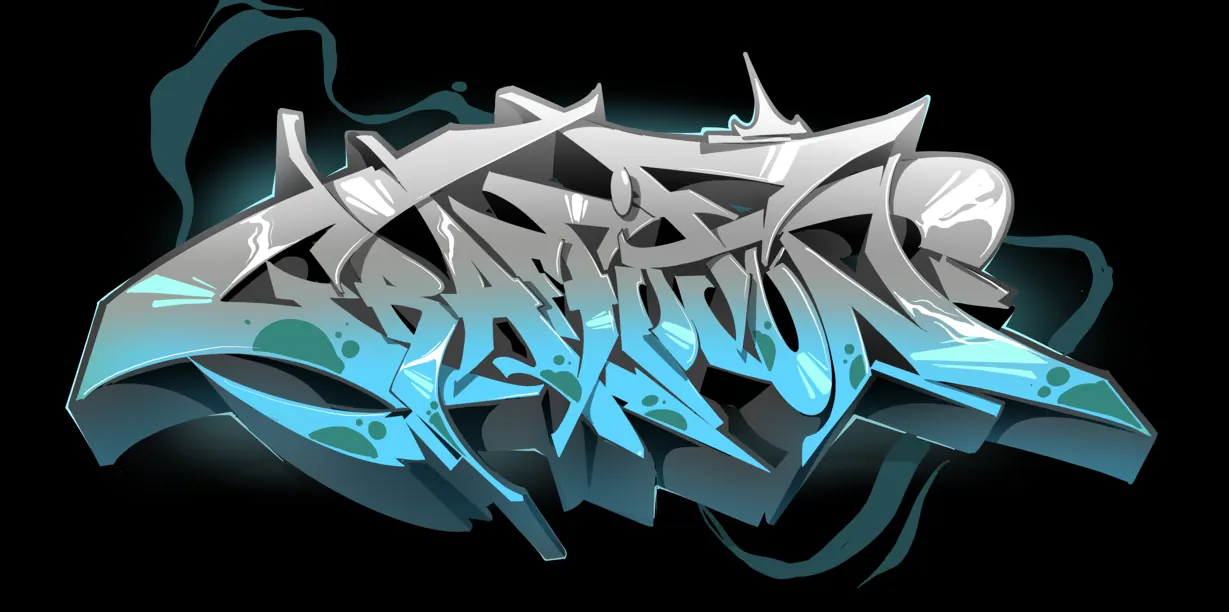
- 3D and Depth: Techniques like "vanishing point" or "block 3D" to make letters pop off the page.
- Backgrounds and Characters: Many artists surround their lettering with elaborate "scenes" or illustrative characters to create a complete composition.
- The "Handstyle": Scattered throughout the pages are various tags, documenting the evolution of the artist's signature.
Practical workshop application: Why we use blackbooks
At Graffitifun, we believe that every great spray-painted mural starts with a solid foundation on paper. In our professional graffiti workshops, we introduce participants to the concept of the blackbook for several vital reasons:
1. Concept Development
Before touching a spray can, students use paper to map out their proportions. It is much easier to correct a pencil line than it is to fix a stray mark of aerosol art. We encourage participants to "catch a flow" on paper first.
2. Safety and Environment
Blackbooks allow for practice in any environment without the need for ventilation or protective gear. It makes the art form accessible to younger participants who may not yet be ready for the physical demands of high-pressure cans. For more on this, see our age guidelines.
3. Portfolio Building for Corporate Teams
In our branding workshops, we use "mini-blackbooks" to help teams brainstorm logos and visual identities. This process mirrors the real-world workflow of a graphic designer or professional muralist, turning abstract ideas into tangible sketches before they hit the final canvas or wall.
Common misconceptions about blackbooks
There are several myths surrounding the use of sketchbooks in graffiti culture that our experts often have to clarify:
- "It's just for beginners": Many assume that once you are "good," you no longer need to sketch. In reality, the most world-renowned artists have stacks of blackbooks spanning decades. It is a lifelong practice.
- "Everything in it must be perfect": A blackbook is a workspace. It is full of mistakes, "toy" (amateur) sketches, and half-finished ideas. It is a place for experimentation where failure is welcomed.
- "They are illegal to carry": In most jurisdictions, a sketchbook is simply art supplies. However, historically, in certain cities, authorities viewed them as "graffiti tools." Today, they are widely recognized as legitimate artistic portfolios.
Difficulty level: From novice to master
The difficulty of "blackbooking" is deceptive. While anyone can draw in a book, mastering the "cleanliness" required for a professional-grade entry takes years.
- Beginner: Focusing on letter structure and basic tags. Developing a consistent "box" or "bubble" style.
- Intermediate: Introducing drips, basic 3D effects, and experimenting with marker blending.
- Advanced: Executing complex burners with photographic realism, interlocking wildstyle letters, and technical precision that rivals digital illustration.
Choosing your materials
If you are starting your own journey, our professional artists recommend starting with a heavy-weight paper (at least 150gsm).
- Markers: Alcohol-based markers are the industry favorite for their blending capabilities.
- Fineliners: Used for the "final outline" to give the piece a sharp, professional look.
- White Paint Pens: Crucial for adding "highlights" or "shines" to letters, mimicking the effect of light hitting the paint.
Conclusion
The blackbook is the heartbeat of graffiti culture. It is the classroom where the greats were taught and the vault where history is kept. Whether you are a corporate professional looking for a creative outlet or a budding artist wanting to make your mark, the blackbook is your most loyal companion 📓.
Expert Attribution
This guide was authored by the Graffitifun editorial team, drawing on over a decade of hands-on experience in the global urban art scene. Our team consists of professional graffiti artists who have maintained their own blackbooks for years, using them to design massive mural art projects and lead educational workshops. We pride ourselves on teaching the authentic "foundation" of graffiti, ensuring that the history and technical skills of the craft are preserved for future generations.
Frequently asked questions
Keep reading
Ready to Create Your Masterpiece?
Book your graffiti workshop today and discover the artist within! It's going to be AWESOME!