Integrating graffiti into STEM education
Discover how graffiti transforms STEM education. Learn the science of aerosols, the math of mural scaling, and the engineering of urban art in this guide.
The intersection of urban art and scientific inquiry
In the evolving landscape of modern education, the integration of Science, Technology, Engineering, and Mathematics (STEM) with the arts—often referred to as STEAM—has proven to be a powerhouse for engagement. Graffiti, traditionally seen as a subculture movement, offers a surprisingly robust framework for teaching complex scientific principles. By leveraging the tactile nature of aerosol art, educators can transform abstract theories into concrete, colourful realities. 🎨
Science: The chemistry of aerosols and pigments
At its heart, Every spray can is a pressurized laboratory. Integrating graffiti into the science curriculum allows students to explore chemistry and physics through a medium they find inherently exciting.
Gas laws and thermodynamics
A spray can operates based on Boyle’s Law and the concepts of pressure and volume. When a student presses the nozzle, they are witnessing a practical application of physics. Educators can discuss how the propellant (liquefied gas) expands as it leaves the high-pressure environment of the can, changing from a liquid to a gas state. This process also involves thermodynamics; students will often notice the can becoming cold after prolonged use, providing a perfect entry point into the Joule-Thomson effect and endothermic processes.
Pigment chemistry and light theory
The composition of the paint itself is a lesson in chemistry. Understanding the binders, solvents, and pigments required to create high-opacity paint helps students appreciate material science. Furthermore, when teaching graffiti shading techniques, students must understand how light interacts with surfaces (optics) and how different pigments absorb or reflect wavelengths of light to create specific hues and values.
Technology: Tools of the trade and digital evolution
Technology in graffiti extends far beyond the physical can. It incorporates digital design, software proficiency, and the evolution of hardware.
Nozzle engineering and fluid dynamics
The "cap" or nozzle of a spray can is a precision-engineered tool. Different caps regulate the flow and spray pattern (fat caps vs. skinny caps). This allows for deep dives into fluid dynamics—exploring how the diameter of an aperture affects velocity and discharge patterns (the Venturi effect). Students can experiment with different pressures and cap designs to see how technology influences the final aesthetic output.
Digital sketches and VR graffiti
Before a drop of paint hits a wall, many professional artists use digital tablets and vector software to map out their designs. Teaching students to use graphic design software to plan a mural bridge the gap between traditional art and modern tech skills. Additionally, Virtual Reality (VR) graffiti simulators are becoming essential educational tools, allowing for risk-free experimentation with scale and perspective without the need for ventilation or expensive materials.
Engineering: Structural planning and scale
Large-scale muralism is an engineering feat. It requires meticulous planning, structural awareness, and mathematical precision.
Scale and proportion (The Grid Method)
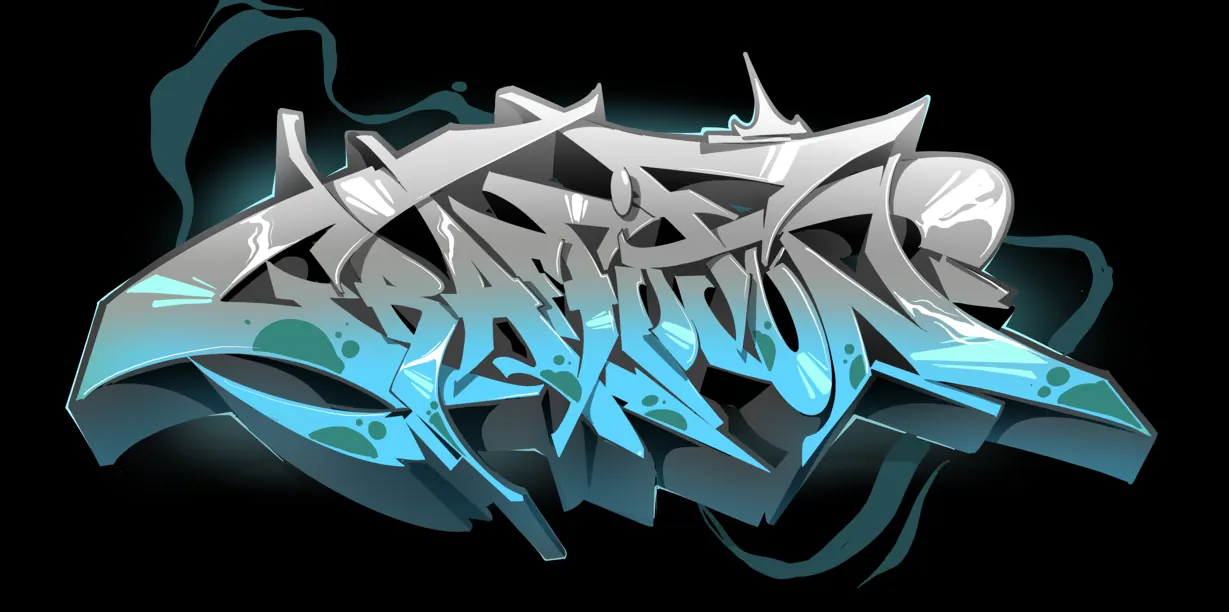
Translating a small sketch onto a 20-foot wall is a geometric challenge. Students learn to use the "Doodle Grid" or traditional Cartesian grids to maintain proportions. This teaches them about ratios, scaling factors, and coordinate geometry. When working on complex lettering like wildstyle graffiti, structural integrity of the letterforms is paramount—if the "skeleton" of the letter is weak, the entire piece fails visually, much like a poorly engineered bridge.
Site assessment and environmental engineering
Before painting, artists must assess the substrate. Is it porous brick? Smooth metal? This is where civil engineering meets art. Students must understand surface tension, weatherproofing, and how environmental factors like UV radiation and moisture will affect the longevity of the structure and the art. This encourages a problem-solving mindset typical of professional engineers.
Mathematics: Geometry in the alleyway
Graffiti is fundamentally an exercise in geometry. From the 3D "blocks" of a piece to the vanishing points in a background, math is everywhere.
3D Perspective and spatial reasoning
Creating depth on a 2D surface is one of the most difficult skills for a budding artist. By teaching vanishing points and horizon lines, educators are teaching spatial reasoning and non-Euclidean geometry. Advanced techniques involving fading and blending help reinforce the concept of gradients and calculus-based transitions in colour density.
Volume and area calculations
On a practical level, students must calculate the surface area of their "canvas" to determine how much paint is required. This involves measuring heights and widths, subtracting "negative space" (windows/doors), and using the coverage rate of specific spray paint brands to estimate budget and materials. This is real-world applied mathematics. 📐
Social impact and pedagogical value
Beyond the technical STEM skills, graffiti in education fosters significant social and emotional growth. It provides a voice to marginalized students and creates a sense of ownership over their learning environment. When a school commissions a student-led mural, it reduces vandalism and increases school pride—a phenomenon known as the "mural effect."
Collaboration and team cohesion
Large-scale projects cannot be done alone. Students must communicate, delegate tasks (background, outlines, fill-ins), and work toward a shared vision. This mirrors the collaborative nature of STEM fields like aerospace or software development. It builds empathy and soft skills that are essential for future career success.
Age-appropriate adaptations
To ensure safety and effectiveness, the STEM-Graffiti curriculum must be tailored to the learners' age groups. It is vital to follow age guidelines for material safety.
- Primary (Ages 7-11): Focus on "Graffiti Math" (shapes and symmetry) using water-based markers or chalk sprays. Discuss the "magic" of how liquid turns to gas.
- Secondary (Ages 12-16): Introduce aerosol chemistry, 1-point and 2-point perspective, and the engineering of the spray can. Use professional-grade low-pressure paints for better control.
- Higher Education (17+): Focus on structural murals, advanced chemical interactions, and the use of digital sensors and projections (projection mapping) to blend tech and art.
Practical workshop application
A typical STEM-integrated workshop should begin with a "theory phase" where the physics of the can is explained. This is followed by a "design phase" where students calculate scale and budget. Finally, the "execution phase" allows them to apply their scientific and mathematical hypotheses to the wall. This hands-on approach ensures that the information is retained far longer than through a textbook alone. 🚀
Expert attribution: The Graffitifun advantage
This comprehensive guide was developed by the expert team at Graffitifun. With years of hands-on experience in the global urban art scene, our professional graffiti artists have transitioned from the streets to the classroom, refining the art of urban art education. We pride ourselves on maintaining the highest standards of safety and professionalism, ensuring that every workshop is not only a creative outlet but a robust educational experience. Our team has successfully implemented these STEM-integrated modules in schools and corporate environments worldwide, proving that the spray can is one of the most versatile teaching tools in the modern educator's arsenal.
Frequently asked questions
Keep reading
Ready to Create Your Masterpiece?
Book your graffiti workshop today and discover the artist within! It's going to be AWESOME!